FLIE In Practice – A conversation with Timo Pauel of QuinteQ Energy Storage
What began as a promising piece of space technology gathering dust on a shelf at Boeing has developed into a Dutch innovation that is helping to make ports, construction sites and large-scale energy projects more sustainable. QuinteQ Energy Storage Based in Culemborg, the company develops flywheel systems for energy storage and is currently working on a major microgrid project for the port of Odessa in Ukraine. Business Development Manager Timo Pauel explains how a combination of technical daring, entrepreneurship and support from FLIE and FME has contributed to the company’s growth. When QuinteQ was founded in 2018, the foundations had already been laid several years earlier. The technology originated from a Boeing aerospace project, in which a flywheel had once been developed to deliver extremely high power peaks. QuinteQ founder Paul Vosbeek recognised its potential beyond the aerospace sector and eventually succeeded in acquiring the global patent portfolio.
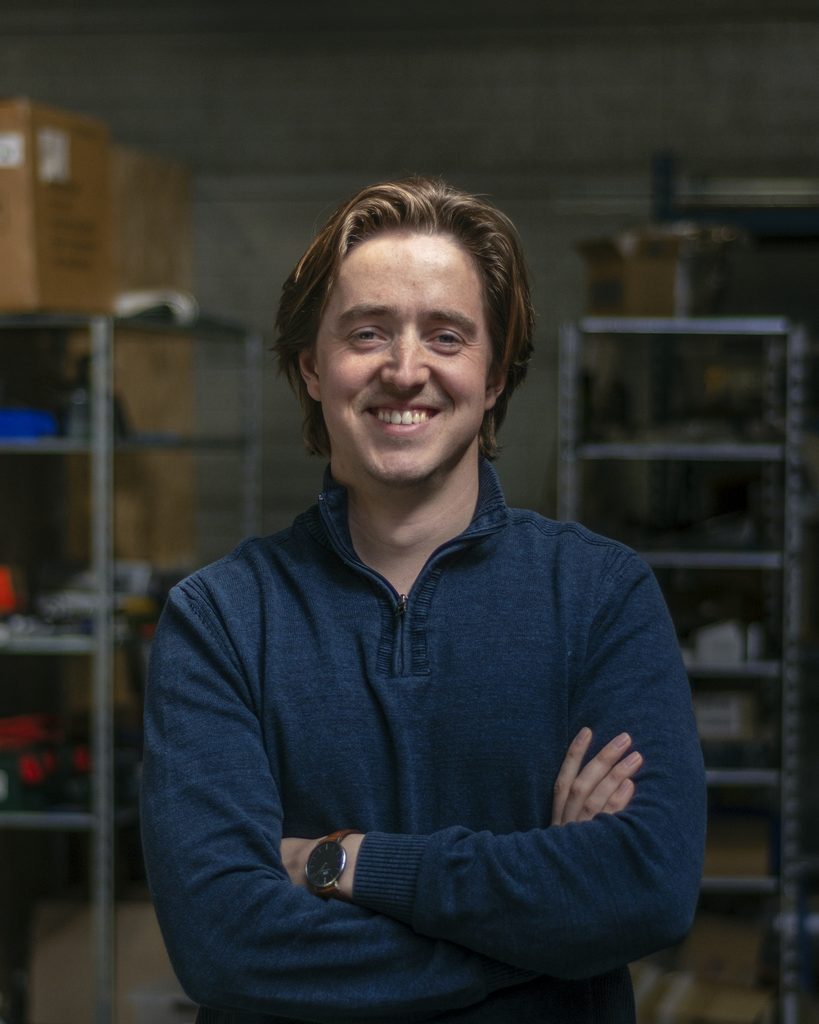
“The Boeing design was the starting point for QuinteQ,” says Timo. “The technology had been developed for space applications and was therefore extremely advanced. We started with a system featuring superconducting magnets, a levitating rotor and all sorts of high-tech components. Technically very impressive, but also complex and expensive. During development and the initial demonstrations, we gained a clearer understanding of what customers actually needed. What’s more, at one point we were forced to re-examine the design when a prototype failed during testing. In hindsight, that proved to be a major turning point. We then moved away from much of the complex technology and started focusing on what really adds value for the user. The result was a much simpler, more robust and more scalable system. The original design got us started, but the reason for our success lies primarily in the choices we made ourselves afterwards: simplifying, listening to the market and building a solution that is commercially viable.”
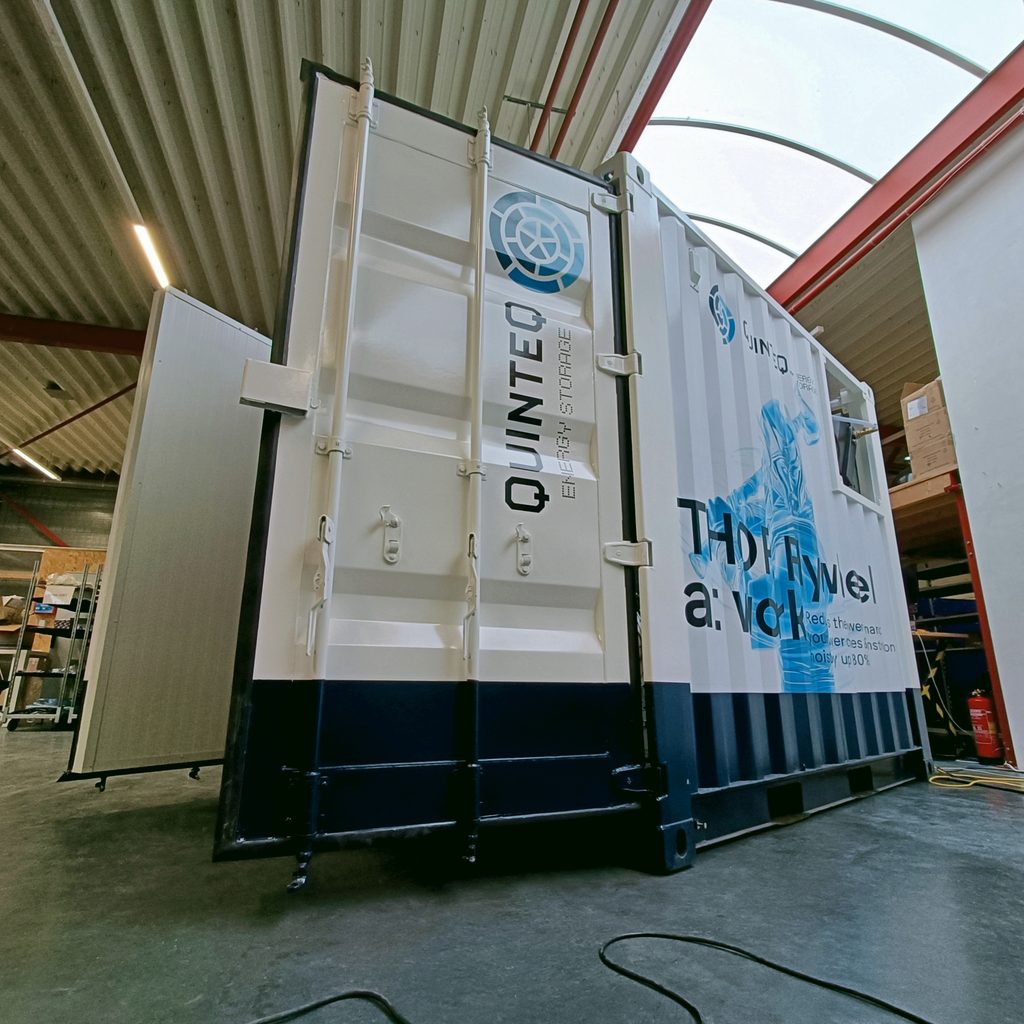
Energy storage for peak power
Whilst batteries are mainly used to store energy over long periods, QuinteQ takes a different approach. The company focuses on applications where an extremely high level of power is required for short bursts. “We store energy mechanically in a flywheel,” explains Timo. “This means we’re particularly well-suited to situations where a great deal of power is required all at once. Think of harbour cranes, tower cranes, construction sites or other installations with peak loads.”
That is precisely what makes the difference. By smoothing out power peaks, the required grid connection can be significantly reduced. “In some applications, we can reduce power demand by as much as eighty per cent. This means that businesses can manage their infrastructure more efficiently, are less affected by grid congestion and can sometimes even make do with a much smaller connection.”
The technology also offers advantages over chemical batteries. For example, a flywheel does not suffer from battery degradation due to intensive charge and discharge cycles, the system has a lifespan of many years, and there is no risk of thermal runaway (a thermal chain reaction – ed.). “It’s not a question of being better or worse than batteries,” Timo emphasises. “They are two different technologies, each with its own strengths. Batteries are excellent for long-term storage. We, on the other hand, excel at handling rapid and heavy peaks.”
From start-up to scale-up
For QuinteQ, recent years have been all about pioneering, exploring and adapting. The company has grown from a small team to around eighteen employees and is now in the scale-up phase. “When I started in 2020, there was actually hardly any budget,” laughs Timo. “I came from the aviation sector and was really keen to contribute to this technology. I even worked without a salary for a while because I believed in what was possible here.”
His brief was clear: find out exactly what problem this technology actually solves. “A great technology alone isn’t enough. You also need to know who’s willing to pay for it.” This ultimately led to a clear focus on sectors such as the construction industry, port logistics and large-scale energy infrastructure. QuinteQ now supplies systems to customers and is working on further international expansion. In addition, the company is exploring new markets, including AI data centres. “These often exhibit a very spiky energy profile. That makes it an interesting market for the future.”
Odessa: a turning point
Every scale-up has moments when everything comes together. For QuinteQ, that moment came with a major project in Ukraine. “Internally, we do talk about a pre-Odessa and a post-Odessa era,” says Timo.
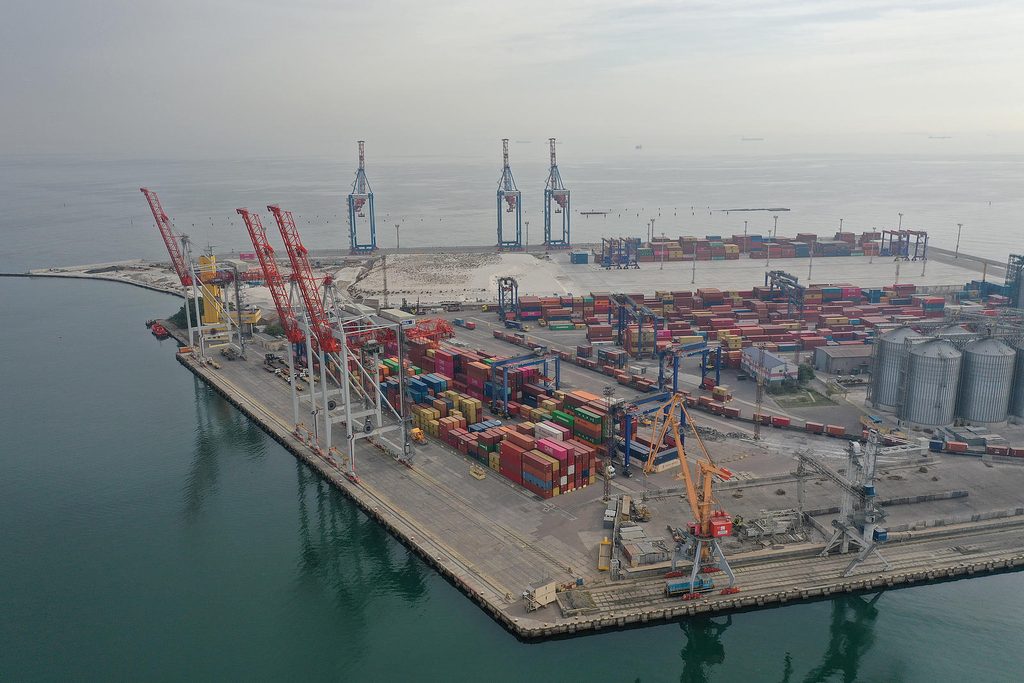
QuinteQ is currently developing a 3.6 MW flywheel system as part of a microgrid for a container terminal in the port of Odessa. The system combines flywheels, batteries, solar panels and generators, enabling the terminal to remain operational in the event of a power cut. “The project aims to make the port less dependent on diesel and more resilient to power cuts. That is, of course, no theoretical issue there.”
The project is currently being designed and built, with completion scheduled for 2027. For Timo and his colleagues, it goes beyond just the technical aspects. “We have always been an impact-driven company. Initially, this was mainly driven by the energy transition. Now we can also make a real contribution to the resilience of a country that faces enormous challenges on a daily basis. That gives extra meaning to what we do.”
‘We’ve moved from a highly sophisticated, complex system to a much simpler and more robust design that better meets our customers’ needs’
Opting for simplicity
Looking back, Timo sees one key lesson that shaped the development of QuinteQ. “The damage to the prototype felt like a setback at the time, but in hindsight it turned out to be a blessing. We were forced to abandon complex technology that wasn’t essential. As a result, we started developing a much simpler, more reliable and more scalable product.” That focus on simplicity ultimately made the difference between an interesting technology and a commercially viable product. “Hardware development is a constant process of trial and error. You’re constantly facing new challenges. But it’s precisely by always focusing on what really adds value for customers that you make progress.”
Ready for the next step
When Timo looks ahead to 2030, he envisages a QuinteQ that operates internationally and is recognised as the leading specialist in applications involving high power peaks. “I expect we will have grown further, possibly be based at a larger site and be running projects worldwide. But more importantly: I hope that flywheels will by then have become the obvious solution within the energy transition.” For although batteries often get the limelight these days, he believes that flywheels will play an indispensable role in a future where the smart use of energy is becoming increasingly important. “We want to be the technology partner that companies think of as soon as they encounter those heavy power peaks. That’s where our strength lies.”
‘The FLIE grant enabled us to take a broader view of product-market combinations and discover new opportunities’
About the partnership with FLIE
The development of QuinteQ was partly driven by an application study carried out by the Industrial Electrification Field Lab. This support gave the company the scope to explore various markets, hold discussions with customers and identify precisely where the technology adds the most value.
At a crucial stage in their development, FLIE offered much more than just financial support. In fact, the collaboration began with a personal milestone for Timo: “I wrote the application for the FLIE grant, and we were awarded it.”.
”So I handed in my notice straight away and was able to start working at QuinteQ. That was my personal ticket into QuinteQ.“ Thanks to the feasibility study, the start-up was given the scope to carry out market research, speak to customers and discover where the unique flywheel technology could actually make a difference. According to Timo, it was precisely that freedom that was invaluable: ”It really gives you much more scope to enter unknown markets and explore product-market combinations that you might not otherwise have considered.“ In addition, QuinteQ benefited from FLIE’s network and guidance. The introductions to relevant parties and the involvement of advisers such as Marco Kirsenstein helped the team with strategic decisions and building a strong network. As Timo sums it up: ”You don’t just get a lump sum of money. You embark on a journey together where you have a sparring partner and gain access to a network.”
The benefits of FME membership
FME membership also brings QuinteQ tangible benefits. As an innovative scale-up in the manufacturing sector, the company can draw on knowledge, support and practical resources that would otherwise take a great deal of time and money to source independently. Timo specifically mentions the support regarding contracts and general terms and conditions. ”We’ve benefited greatly from FME on those topics in particular,” says Timo. “There are certain things that, as a scale-up, you don’t have to figure out all by yourself. It’s great when that knowledge is already available.” Furthermore, QuinteQ feels at home within the FME network, as its membership means the company is part of the Dutch technological manufacturing sector, where it can build up both knowledge and visibility. Together, FLIE and FME have helped QuinteQ grow from a promising technology into a company that now carries out international projects, including the large-scale energy project in the port of Odessa.
Want to find out more about QuinteQ Energy Storage? Go to www.quinteqenergy.com.
About FLIE
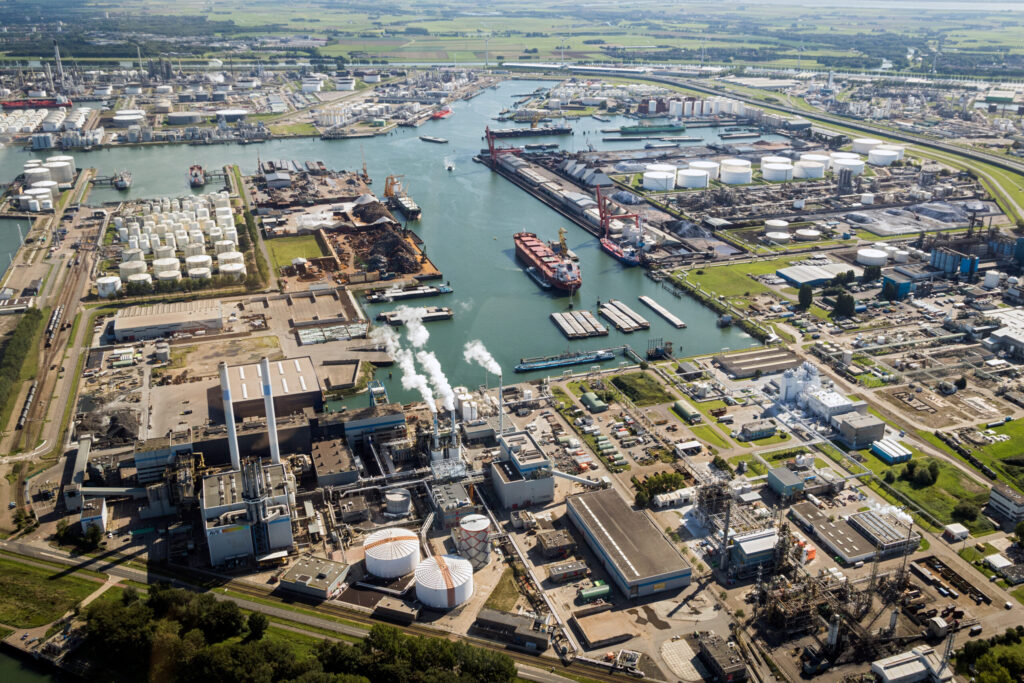
FLIE is a joint initiative of Deltalinqs, FME, the Port of Rotterdam, InnovationQuarter, Platform Zero and TNO, and is closely supported by the Province of South Holland, the City of Rotterdam and the ERDF grant